Last updated: September 1, 2026
Proton VPN Review 2026: Is It One of the Best VPNs for Privacy?
Proton VPN combines a privacy-first business model with a broader consumer feature set than many minimalist VPNs. Its strongest arguments are open-source applications, recurring independent no-logs audits, Swiss jurisdiction, Secure Core, NetShield, Stealth, a genuinely useful free plan, and integration with the wider Proton privacy ecosystem.
In this review, we look at what Proton VPN actually does well, where the free and paid plans differ, how Secure Core works, what its current 2026 server network looks like, and whether Proton VPN is a better fit than Mullvad or NordVPN.
One of the best all-around privacy VPNs for users who want strong transparency and security without giving up streaming, speed, mobile usability, or a broader privacy ecosystem.
How We Reviewed Proton VPN
A useful VPN review should look beyond a company's marketing page. We evaluate VPNs based on privacy architecture, independent verification, protocols, leak protection, server network, speed, application quality, censorship resistance, P2P support, streaming usability, pricing, device limits, and how clearly the provider communicates limitations.
What Is Proton VPN?
Proton VPN is a privacy-focused VPN developed by Proton, the company behind Proton Mail, Proton Pass, Proton Drive, Proton Calendar and other privacy-oriented products.
When you connect to Proton VPN, your device creates an encrypted tunnel to a Proton VPN server. Websites normally see the VPN server's IP address rather than your usual public IP address, while your local network or ISP sees encrypted traffic going to the VPN service rather than the final destination content.
WITHOUT A VPN
WITH PROTON VPN
Proton VPN Desktop & Mobile App Screenshots
The application experience matters because most users interact with a VPN through the app rather than through its technical documentation. Proton's apps are designed around Quick Connect, country/server selection and simple privacy controls, with advanced options available when needed.
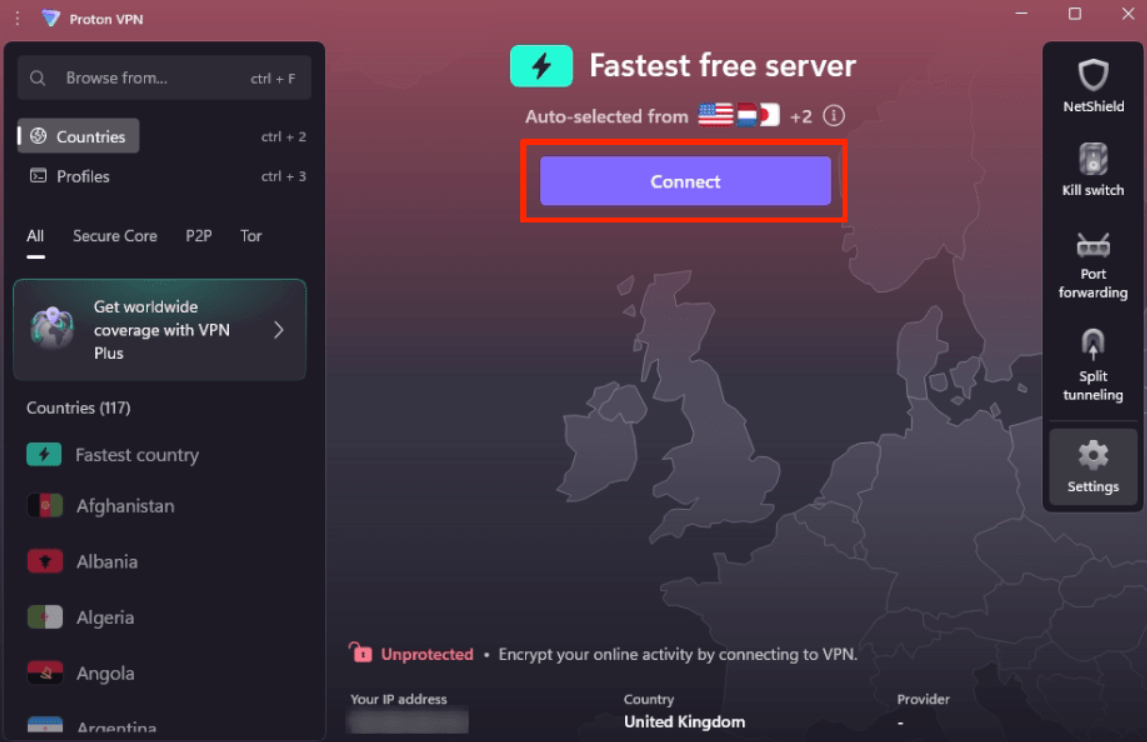
Proton VPN Desktop App
The desktop interface gives quick access to countries, servers, connection status, Secure Core, profiles and privacy settings.
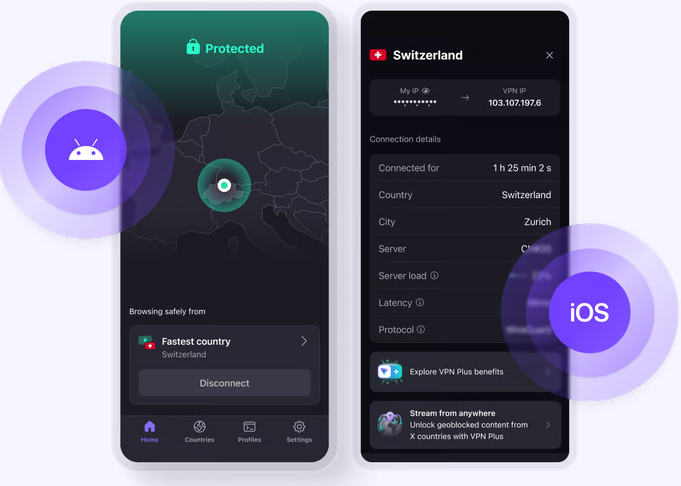
Proton VPN Mobile App
The Android and iPhone apps keep the core connection workflow simple while providing access to server locations, Secure Core, NetShield and protocol settings.
images/proton-vpn-desktop.png and images/proton-vpn-mobile.png.Privacy, No-Logs Policy & Independent Audits
Proton's privacy claims are stronger than a simple "we don't log" statement because the company has repeatedly subjected its VPN infrastructure to independent review.
In 2026, Proton announced its fifth consecutive annual no-logs audit by Securitum. The review covered the infrastructure behind the no-logs claim rather than merely checking the wording of a privacy policy.
Proton's published transparency information also says that requests seeking identifying connection information have been denied because the service does not retain the logs needed to identify which user was connected to a particular server at a particular time.
Swiss jurisdiction
Proton VPN is based in Switzerland. Swiss jurisdiction is not a magic shield from lawful requests, but the more important issue is what the provider actually stores. A privacy-focused architecture is more meaningful when a provider does not possess the historical activity information being requested.
Open-source applications
Proton publishes the source code for its VPN apps. Open source does not automatically make software secure, but it makes privacy claims more inspectable and allows independent researchers to scrutinize the application code.
Secure Core: Proton VPN's Standout Privacy Feature
Secure Core is designed for users who want additional protection against attacks on VPN exit infrastructure. Instead of sending traffic directly through a normal exit server, Secure Core first routes it through a hardened Proton-controlled server in a privacy-friendly jurisdiction before reaching the exit location.
NORMAL VPN
SECURE CORE
Proton says its Secure Core servers are owned and operated by the company and located in Switzerland, Iceland and Sweden, with traffic then exiting through supported countries.
Security, Kill Switch & Leak Protection
Proton VPN includes the core controls expected from a serious privacy VPN: encrypted tunnels, a kill switch, always-on behavior on supported platforms, DNS leak protection and IPv6 leak protection.
Kill Switch
Blocks traffic if the VPN connection unexpectedly drops so the device does not silently return to the normal connection.
Always-On VPN
Automatically attempts to reconnect the VPN after a disruption on supported platforms.
DNS Leak Protection
Routes DNS requests through Proton's encrypted tunnel and DNS infrastructure.
IPv6 Protection
Helps prevent IPv6 traffic from bypassing the VPN and revealing a real network address.
Protocols: Smart Protocol, WireGuard & Stealth
Proton VPN's current protocol strategy is more nuanced than simply saying it supports every protocol on every platform. The exact choices vary by operating system.
Smart Protocol
Smart Protocol is enabled by default on supported apps and automatically selects an appropriate VPN protocol based on the network environment. For most users, this is the best default.
WireGuard
WireGuard is a modern, lightweight protocol and is widely available across Proton's apps. It is generally the best starting point when speed and efficiency matter.
Stealth
Stealth is Proton's censorship-resistant protocol. It is designed to make VPN traffic harder for restrictive networks to identify and block.
NetShield Ad, Tracker & Malware-Domain Blocking
NetShield is a DNS-based filtering feature available on paid plans. It can block known malware domains, ads and trackers before the browser or application completes the connection.
In early 2026, Proton expanded NetShield so it can block subdomains in addition to root domains, significantly increasing the number of ad, tracker and malware-related requests the system can intercept.
NetShield is useful as an additional privacy and security layer, but it should not be treated as a complete replacement for endpoint security, software updates or safe browsing habits.
Tor Over VPN
Proton also provides Tor over VPN on supported paid servers. Traffic first enters the Proton VPN tunnel and then passes into the Tor network.
This is a specialized feature. Tor introduces additional hops and typically much higher latency, so it is not something most users should enable for ordinary browsing.
Speed, Performance & VPN Accelerator
Proton VPN's paid network includes high-capacity servers and the company advertises 10 Gbps-capable infrastructure. It also uses VPN Accelerator, a collection of technologies intended to improve throughput and long-distance VPN performance.
Proton has historically described improvements of up to 400% in specific long-distance or poor-network conditions. That should not be interpreted as a promise that every user gets four times their normal internet speed.
- Distance to the VPN server affects latency.
- Your ISP connection sets the upper limit on throughput.
- Wi-Fi quality and local congestion matter.
- Protocol choice can affect speed.
- Secure Core and Tor over VPN usually add more latency than a direct VPN connection.
Proton VPN Free: Is the Free Plan Actually Useful?
Yes. Proton VPN's free plan is one of its strongest differentiators because it has no data cap and uses the same basic privacy model rather than funding the service through advertising or selling browsing data.
Unlimited data
The Free plan does not impose a monthly bandwidth or data allowance.
10 countries
Free users can connect through Proton's current pool of free server countries, with server selection managed differently from paid plans.
1 device
The Free plan supports one active VPN connection at a time.
No ads or activity logging
Proton says the free service uses the same core no-logs philosophy as the paid service.
The main limitations are server choice, premium features, P2P support and streaming guarantees. If you need Secure Core, NetShield, P2P, premium streaming support, full server selection or 10-device coverage, VPN Plus is the relevant upgrade.
Streaming & Torrenting
Streaming
Paid Proton VPN plans are designed to support major streaming services. The large server network and high-capacity infrastructure make Proton more versatile for entertainment than some privacy-minimalist VPNs.
Streaming compatibility still changes over time because platforms continually update VPN-detection systems. No VPN should promise permanent access to every regional library.
Torrenting and P2P
Proton VPN supports P2P/BitTorrent traffic on Plus servers. Paid users can combine P2P support with the kill switch and no-logs architecture.
As always, a VPN does not change copyright law. Use P2P services only for lawful activity.
Proton VPN for India
For users in India, Proton VPN is useful both for securing ordinary browsing and for connecting to international server locations. Proton's Secure Core coverage has also expanded to include an Indian exit option.
When speed matters, users in India should test nearby standard servers rather than assuming a particular location will always provide the best performance. ISP routing can make a geographically close server slower than another nearby region.
Proton VPN Pricing in 2026
Proton's VPN lineup is centered on the Free plan, VPN Plus, and Proton Unlimited. Pricing varies by billing period and promotions, so static dollar amounts can become outdated quickly.
| Plan | Best For | Key VPN Differences |
|---|---|---|
| Proton Free | Basic privacy | Unlimited data, one device, free server pool, no premium features. |
| VPN Plus | Full VPN experience | 10 devices, 20,000+ servers, streaming, P2P, NetShield, Secure Core and premium speeds. |
| Proton Unlimited | Broader privacy ecosystem | Includes VPN Plus features alongside premium Proton Mail, Pass, Drive and Calendar services. |
Proton VPN vs Mullvad
| Category | Proton VPN | Mullvad |
|---|---|---|
| Open-source apps | Yes | Yes |
| No-logs audits | Recurring independent audits | Independent security assessments |
| Anonymous-style account setup | Conventional Proton account | Random account number, no email required |
| Free plan | Yes | No |
| Devices | 10 on VPN Plus | 5 |
| Privacy ecosystem | Very broad | VPN-focused |
| Best for | Privacy + mainstream usability | Maximum data minimization |
Mullvad has the stronger argument if account data minimization is your highest priority. Proton is stronger if you want a privacy-first VPN plus a free plan, broader ecosystem, streaming support and more simultaneous devices. Read our Mullvad VPN review.
Proton VPN vs NordVPN
| Category | Proton VPN | NordVPN |
|---|---|---|
| Open-source apps | Yes | Partially open-source ecosystem/components |
| No-logs verification | Five consecutive annual audits | Repeated independent reviews |
| Free plan | Yes | No |
| Privacy-specific feature | Secure Core | Double VPN / specialty servers |
| Broader ecosystem | Mail, Pass, Drive, Calendar | Security and privacy bundle |
| Best for | Privacy-first all-around use | Feature-heavy mainstream VPN use |
Both are strong mainstream VPNs. Proton leans harder into open-source transparency and the privacy ecosystem, while NordVPN emphasizes performance, specialty servers and a broader security bundle. Read our NordVPN review.
Proton VPN Pros & Cons
Pros
- Open-source applications
- Five consecutive annual no-logs audits through 2026
- Swiss jurisdiction
- Secure Core
- Kill switch and always-on protection
- DNS and IPv6 leak protection
- Stealth censorship-resistant protocol
- NetShield ad/tracker/malware-domain filtering
- Unlimited-data free plan
- 20,000+ servers across 140+ countries on paid plans
- Up to 10 simultaneous devices on VPN Plus
- Strong wider Proton privacy ecosystem
Cons
- Account setup is less minimalist than Mullvad
- Many advanced features require a paid plan
- Secure Core and Tor over VPN can reduce speed
- Free plan allows only one device at a time
- The broad ecosystem may be more than basic users need
- Protocol availability varies by platform
Who Should Use Proton VPN?
- Privacy-conscious everyday users who want strong protection without an overly technical interface.
- People who need a trustworthy free VPN with unlimited data.
- Travelers and remote workers who regularly use public or untrusted networks.
- Users building a broader privacy setup around Proton Mail, Pass, Drive and Calendar.
- Users in restrictive networks who may benefit from the Stealth protocol.
- Advanced users who can make use of Secure Core, Tor over VPN, NetShield and protocol controls.
Who Should Consider Another VPN?
If anonymous-style account creation and maximum data minimization are your top priorities, Mullvad is a stronger fit. If you want only a very simple low-cost VPN and do not care about the Proton ecosystem, another provider may offer better value.
How to Set Up Proton VPN
Create a Proton account
Choose the Free plan or a paid VPN plan through Proton's official site.
Install the official app
Download Proton VPN for Windows, macOS, Linux, Android or iOS.
Sign in and use Quick Connect
For most users, Smart Protocol and Quick Connect are the simplest starting point.
Review the kill-switch setting
If exposing the normal IP address would be a problem, configure the kill switch before relying on the VPN.
Enable advanced features only when useful
Use Secure Core, Stealth, NetShield or Tor over VPN when your use case justifies them.
Frequently Asked Questions
Is Proton VPN really private?
Proton VPN combines a no-logs architecture, open-source applications, recurring independent audits, Swiss jurisdiction, Secure Core, leak protection and transparency reporting. No VPN provides complete anonymity, but Proton has one of the stronger transparency records among mainstream VPN providers.
Is Proton VPN free?
Yes. The Free plan has unlimited data, no advertising-based business model, access to free servers in ten countries, and one active device at a time.
How many devices can use Proton VPN?
The Free plan supports one device at a time. Proton VPN Plus supports up to 10 simultaneous connections.
Does Proton VPN keep logs?
Proton states that it does not keep activity logs or user-identifiable connection metadata. Its no-logs infrastructure has undergone five consecutive annual audits through 2026.
What is Secure Core?
Secure Core routes traffic through a hardened Proton-controlled server in Switzerland, Iceland or Sweden before it exits through another VPN location, adding protection against attacks on exit infrastructure.
Does Proton VPN work for streaming?
Paid plans are designed to support major streaming services. Availability can still change as streaming platforms update VPN detection systems.
Does Proton VPN support torrenting?
Yes. P2P and BitTorrent support are available on Plus servers.
Is Proton VPN better than Mullvad?
Mullvad is stronger on account data minimization, while Proton VPN offers a broader privacy ecosystem, a free plan, Secure Core, more simultaneous devices and stronger mainstream streaming support.
Is Proton VPN better than NordVPN?
Proton is especially strong on open-source transparency and its privacy ecosystem, while NordVPN emphasizes specialty server features and a broader mainstream security bundle. The better choice depends on priorities.
Final Verdict: Is Proton VPN Worth It in 2026?
Yes. Proton VPN is one of the strongest all-around privacy VPNs in 2026 because it combines privacy engineering with a mainstream user experience rather than forcing users to choose between the two.
The service's strongest evidence is not a single feature. It is the combination of open-source apps, five consecutive annual no-logs audits, a published transparency record, Secure Core, modern protocols, NetShield, kill-switch protection, DNS/IPv6 leak protection, a useful free plan, and a very large paid server network.
Mullvad remains the better fit for users whose top priority is minimizing account information. NordVPN remains highly competitive for users focused on performance and broad security features. Proton's advantage is balance: strong privacy, strong transparency, good usability, a genuine free tier and a wider privacy ecosystem.
Learn More About Proton VPN →